How Eco-Friendly Tech Is Empowering Digital Nomadism
7 August 2026
The digital nomad lifestyle has long carried a quiet contradiction. You work from a beach in Thailand, a café in Lisbon, or a van in the American Southwest, and you tell yourself you are free. But freedom has a carbon cost. Every flight, every coworking space with air conditioning blasting, every disposable coffee cup from a chain you barely like adds up. The industry that sells you this lifestyle rarely talks about that. It sells you Wi-Fi speed and sunset photos, not the environmental weight of your mobility.
That is changing. Not because nomads suddenly became saints, but because the tools they use are getting smarter, lighter, and more efficient. Eco-friendly tech is not just a marketing angle anymore. It is becoming the backbone of sustainable long-term travel. And it is doing so in ways that are practical, measurable, and often invisible until you stop to notice.

The Real Problem: It Is Not Just the Flights
Most conversations about sustainable travel fixate on aviation. That is understandable. A single long-haul flight can emit more carbon than a year of driving. But for digital nomads, the problem is more layered. You are not just moving people. You are moving a workspace. That means power-hungry laptops, external monitors, portable batteries, cameras, drones, and a tangle of chargers that all draw energy from grids that are rarely clean.The average laptop uses around 60 watts per hour under load. Add a second screen, a mobile hotspot, and a fan to keep yourself cool in a tropical climate, and you can easily pull 150 watts continuously. Over a 40-hour workweek, that is 6 kilowatt-hours. Multiply that by 12 months of travel, and you are looking at over 3,000 kilowatt-hours of electricity just for work. That is roughly the annual consumption of a small household. And most of that energy comes from fossil fuels in the countries nomads favor, like Indonesia, Mexico, or Vietnam.
So the first shift is not about buying a bamboo phone case. It is about reducing the raw energy demand of your mobile office.
Low-Power Hardware Is the Quiet Winner
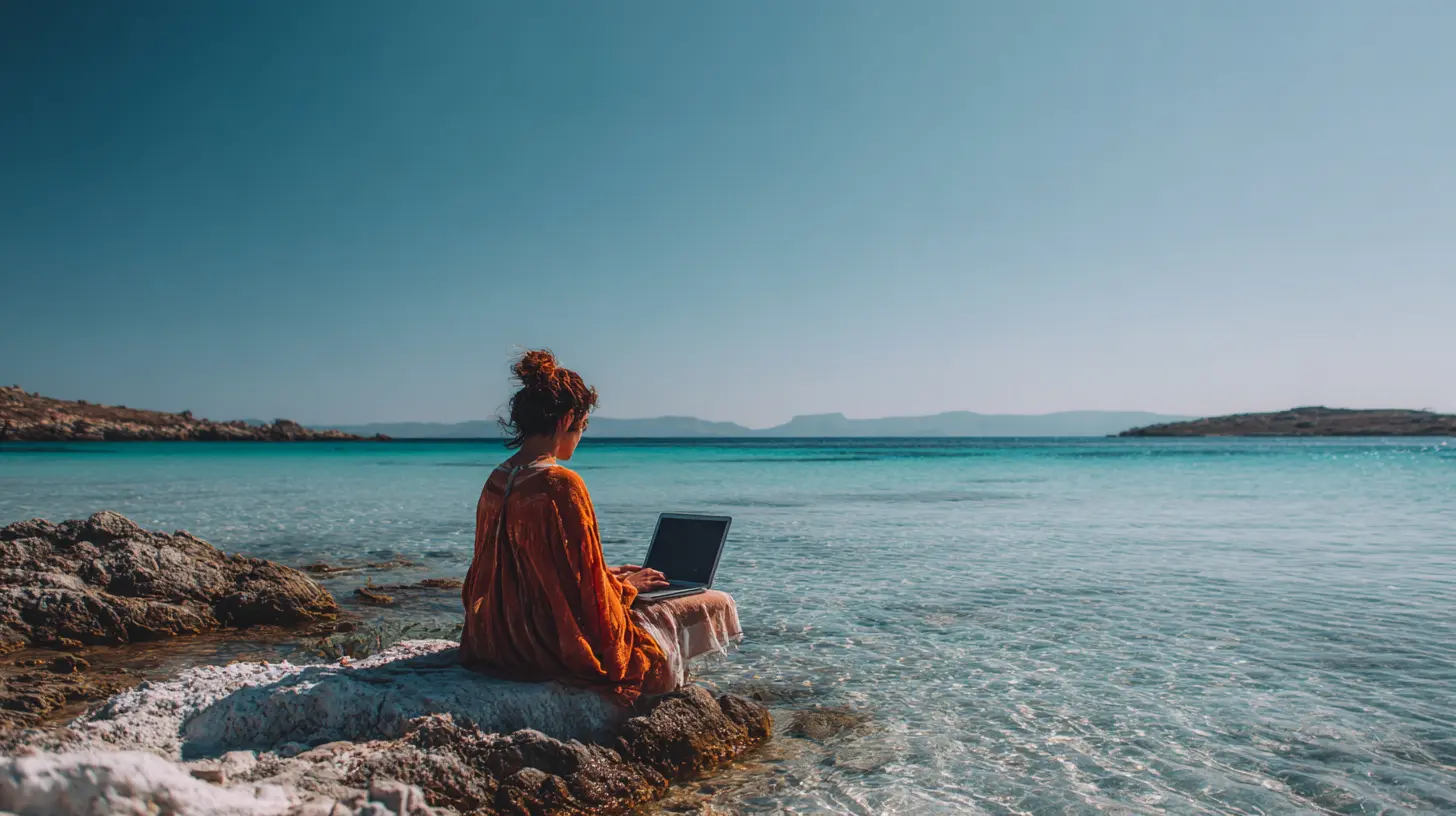
The most impactful change in recent years has been the move toward ARM-based laptops. Apple's M-series chips, Qualcomm's Snapdragon X series, and similar processors deliver desktop-class performance at a fraction of the power draw of traditional x86 chips. An M2 MacBook Air, for example, can run a full development environment or video editing timeline while drawing only 10 to 15 watts. Compare that to a gaming laptop that pulls 150 watts just to idle. The difference is not incremental. It is an order of magnitude.This matters because it changes what you need to carry. With a low-power laptop, you can work for eight hours on a single charge. That means you do not need a massive 100-watt power bank. You do not need to hunt for a wall outlet every two hours. You can work from a park bench, a train, or a beach shack without feeling tethered to infrastructure. And when you do need to charge, a 30-watt solar panel can actually keep up with your usage over a day, something that was impossible with older hardware.
The trade-off is real. ARM chips are not perfect for every workload. Some legacy software, particularly certain Windows-only enterprise tools or niche plugins, still has compatibility issues. If you are a 3D artist relying on CUDA acceleration, an ARM laptop is not ready for you. But for the vast majority of nomads, writers, developers, marketers, data analysts, and customer support agents, the switch is painless and the energy savings are enormous.
Solar Charging Has Finally Grown Up
Portable solar panels have been a joke for years. Thin-film panels were fragile, inefficient, and barely trickled enough power to charge a phone. That has changed with the advent of rigid and semi-flexible monocrystalline panels, often folded into briefcase-style designs. A 100-watt panel from a reputable brand now weighs around 3.5 kilograms and folds down to the size of a thick laptop. In direct sunlight, it can produce 80 to 90 watts in practice, enough to charge a MacBook Air or a 20,000 mAh power bank in a few hours.The key insight is not to rely on solar as your primary source. That is a mistake. Solar is intermittent, weather-dependent, and requires you to sit near your panel while it charges. Instead, treat it as a top-up system. Work from a café in the morning, then set up the panel on your balcony or roof in the afternoon while you go for a swim. By evening, your laptop is full again without touching the grid.
This approach works best in sunny, low-latitude countries. In Northern Europe or during winter, solar is nearly useless. Do not force it. Carry a panel only if your itinerary genuinely supports it. Otherwise, the manufacturing and shipping footprint of the panel itself outweighs the benefit. That is a nuance most green-tech articles miss.
Battery Technology Is the Hidden Enabler
The real revolution is not in panels but in batteries. Lithium iron phosphate, or LiFePO4, has become the standard for portable power stations. Unlike older lithium-ion packs, LiFePO4 cells last for thousands of cycles, tolerate deeper discharges, and are much less likely to catch fire. They are heavier per watt-hour, but for a nomad carrying a 300-watt-hour unit, the weight difference is acceptable.A good power station, like those from EcoFlow, Jackery, or Bluetti, does more than store energy. It also acts as a UPS for your laptop, a charger for your drone, and a way to run small appliances like a mini fridge or a CPAP machine. The practical benefit is that you can decouple your work schedule from the availability of wall outlets. You can work from a remote cabin, a tent, or a train with no power sockets, and still deliver your deadlines.
The mistake many nomads make is buying a power station that is too large. A 1,000-watt-hour station weighs around 10 kilograms and takes up serious bag space. Unless you are living in a van or a boat, that is overkill. A 300-watt-hour unit is enough for a laptop, a phone, a camera battery charger, and a few small accessories. It weighs about 3 kilograms and fits in a daypack. Match the capacity to your actual needs, not your imagined ones.
The Rise of Energy-Efficient Coworking
Coworking spaces are the default office for many digital nomads. But they are often energy hogs. Open-plan spaces with floor-to-ceiling glass, air conditioning set to 18 degrees Celsius, and dozens of laptops running simultaneously create a massive carbon footprint. The irony is that many of these spaces market themselves as eco-friendly because they have a plant wall or use recycled furniture.A better approach is to choose coworking spaces that are genuinely efficient. Look for buildings with natural ventilation, ceiling fans, and operable windows. In tropical climates, a space that uses fans instead of AC can cut energy use by 80 percent. In temperate climates, look for spaces that use heat pumps rather than resistive electric heaters. Some spaces now publish their energy usage or hold certifications like LEED or BREEAM. These are not perfect, but they are a signal.
The deeper point is that the choice of workspace is a choice about energy. A nomad who spends eight hours a day in an inefficient space is undoing the benefit of a low-power laptop. You cannot have a sustainable mobile office if your office is a glass box in the sun.
Digital Infrastructure Is the Most Underrated Eco-Tool
The biggest environmental win for digital nomads has nothing to do with gadgets. It is the shift to cloud-based work. Ten years ago, a nomad needed a powerful laptop with a large SSD, external hard drives, and maybe a local server for file sharing. Today, almost everything runs in the cloud. Documents live in Google Drive or Notion. Code lives in GitHub. Design assets live in Figma. Video editing can be done remotely on cloud workstations.This shift means your local device can be low-power, because the heavy lifting happens in data centers. And modern data centers, especially those run by Google, Amazon, and Microsoft, are increasingly powered by renewable energy. Not all of them, and not all the time, but the trend is strong. When you offload rendering or compilation to a cloud server, you are effectively moving your energy consumption from a dirty grid in a developing country to a cleaner grid in a region with hydro, wind, or solar.
The trade-off is latency and data cost. Cloud computing requires a stable, fast connection. If you are in a remote area with patchy 4G, cloud editing is a nightmare. The solution is to use hybrid workflows. Keep your heavy processing local when you have no internet, and sync to the cloud when you do. This is not a moral choice. It is a practical one. But it has the side effect of reducing your local energy draw.
Misconceptions about E-Waste
A common myth is that buying new eco-friendly tech automatically reduces your footprint. That is false. The most sustainable device is the one you already own. Manufacturing a new laptop creates roughly 300 kilograms of CO2 equivalent, mostly from mining and refining rare earth metals, aluminum, and lithium. If you replace a working laptop every two years just to get a slightly more efficient model, you are making the problem worse.The better strategy is to extend the life of your current devices. Upgrade RAM and storage where possible. Replace batteries instead of buying new units. Use protective cases and keyboard covers to avoid damage. When you do buy, choose repairable brands like Framework, Fairphone, or even standard business laptops from Lenovo or Dell, which have accessible parts. Avoid soldered storage and RAM. They make repair impossible and force premature replacement.
Also, do not forget the second-hand market. A two-year-old flagship laptop is often 40 percent cheaper than a new one and still has years of life left. Buying used keeps that device in circulation, which is the highest form of recycling. This is a hard sell in a culture that fetishizes the latest release, but it is the single most effective eco-choice you can make.
Practical Steps for a Lighter Footprint
Let us move from theory to action. Here is a concrete checklist for any digital nomad who wants to reduce their environmental impact without sacrificing productivity.First, audit your power draw. Use a simple plug-in watt meter to measure how much energy your laptop, chargers, and accessories actually use. You will likely find that your phone charger is negligible, your monitor is not, and your laptop under load is the main consumer. Once you know your baseline, you can size your battery and solar correctly.
Second, switch to a 65-watt USB-C GaN charger. These are compact, efficient, and replace multiple chargers for your laptop, phone, and tablet. They have a small footprint in your bag and a smaller one on the grid. Avoid cheap chargers that waste energy as heat.
Third, use power-saving settings on your devices. Set your laptop to optimize for battery life, lower screen brightness, and disable background apps. This is not just about stretching battery life. It reduces the total energy you draw from the grid over a year. Small changes add up.
Fourth, choose accommodations with energy-conscious hosts. Many Airbnb and guesthouse listings now mention solar panels, efficient water heaters, or natural cooling. Ask directly if the property uses air conditioning or fans, and whether the water is heated by gas or electricity. These details matter more than the style of the furniture.
Fifth, offset your flights, but do it properly. Do not buy random carbon offsets from airlines. They are often low-quality and do not fund real reductions. Instead, contribute to verified projects like those certified by Gold Standard or Climate Neutral. Or, better yet, reduce your flight frequency. Stay in one region for months instead of hopping countries weekly. Slow travel is not just a vibe. It is a carbon strategy.
The Trade-Offs You Need to Accept
There is no perfect setup. Every eco-friendly choice comes with a compromise. Low-power laptops are less powerful. Solar panels require sunlight. Power stations add weight. Cloud computing needs internet. The key is to make choices that fit your specific work pattern.A writer who works from cafes and does not need much compute can easily go with an ARM laptop and a small power bank. A video editor who renders 4K footage needs a powerful machine, and no amount of solar will run it. That editor should focus on cloud rendering and a laptop with a high-efficiency display, rather than pretending a solar panel will save them.
Similarly, a nomad in Southeast Asia can rely on solar and fans because the climate is warm and sunny. A nomad in Norway cannot. The same advice does not apply everywhere. That is why generic "10 tips for eco-friendly travel" articles are useless. They ignore context.
The Role of Community and Infrastructure
Individual choices matter, but they are not enough. The broader shift happens when the infrastructure supports it. This includes coworking spaces that offer bike storage, showers, and efficient lighting. It includes cities with reliable public transit, walkable neighborhoods, and charging points for e-bikes and scooters. It includes visa policies that allow nomads to stay longer in one place, reducing the pressure to fly frequently.Some destinations are getting this right. Portugal's Digital Nomad Village on Madeira promotes slow living and remote work in a nature-rich setting. Bali has seen a rise in eco-conscious coliving spaces that use solar water heating and compost toilets. Chiang Mai has a robust network of bike lanes and a culture of walking. These are not just lifestyle choices. They are structural responses to the environmental cost of mobility.
As a nomad, you can support these places by voting with your wallet. Stay longer, spend locally, and choose spaces that are genuinely trying to be efficient. Avoid the trap of greenwashing. A bamboo water bottle is not eco-friendly if you fly to a new country every two weeks.
The Future Is Not about Guilt
The most important mindset shift is to stop thinking about eco-friendly tech as a form of personal penance. It is not about being pure or perfect. It is about being smarter. A low-power laptop is not a sacrifice. It is a better tool because it lets you work longer without a charger. A solar panel is not a burden. It is a way to work from places you otherwise could not. A power station is not extra weight. It is independence from unreliable grids.The technology is enabling a new kind of freedom, one that is not tied to the nearest outlet or the nearest airport. That is the real empowerment. You can be a digital nomad without pretending your lifestyle has no cost. You can acknowledge the cost and then use the tools available to reduce it. That is not guilt. That is maturity.
The industry will continue to improve. Batteries will get lighter. Solar will get more efficient. Cloud services will move to 100 percent renewable energy. But none of that matters if you do not adjust your own habits. The best eco-friendly tech is the one you actually use, in a way that fits your life. Start there, and the rest follows.
all images in this post were generated using AI tools
Category:
Digital Nomad TechAuthor:

Ugo Coleman
Discussion
rate this article
1 comments
Lexi Velez
Eco-friendly tech is crucial for digital nomads, enabling sustainable lifestyles while staying connected and productive in diverse environments.
August 8, 2026 at 4:51 AM
Ugo Coleman
Absolutely! Eco-friendly tech allows digital nomads to embrace sustainability without compromising their productivity or connectivity. It's a win-win for our planet and their lifestyles.