Designing a Smart Home Office with 2027 Tech
31 May 2026
Let me paint you a picture. It is 2027. You wake up, grab your coffee, and walk into a room that does not just house your desk. It knows you. It breathes with you. It anticipates your next move before your fingers even touch the keyboard. This is not a fantasy. This is the smart home office of 2027, and it is closer than you think.
We are standing at a weird, wonderful crossroads. The pandemic years turned our bedrooms into boardrooms, and we all learned the hard way that a bad home office can break your spirit. But the tech that is coming in the next few years is not about adding more screens or faster Wi-Fi. It is about creating a space that feels alive. A space that adapts to your energy, your focus, and your need to occasionally just stare at the wall without guilt.
So, how do you design this thing? Let me walk you through the blueprint, room by room, bit by bit. No fluff. Just the real, poetic, slightly weird future of work.

The Walls That Listen
Forget the dead, drywall prison of the past. In 2027, your office walls are alive. I am talking about smart surfaces that are not just noise-canceling but context-aware. Think of them as the skin of your workspace.You will have panels that use embedded micro-vibration sensors to detect the hum of traffic outside or the barking dog next door. They do not just block sound. They neutralize it. They create a bubble of silence that follows you. If you shift your chair two feet to the left, the bubble shifts with you. It is like having a personal sound field, and it works without headphones.
And the visual side? These walls are also programmable. Not with ugly, pixelated digital art, but with subtle, organic textures. You can set them to mimic the soft light of a forest at dawn, or the crisp, sterile white of a library. The technology uses something called nano-pigment layers. They shift color and pattern based on your circadian rhythm. When it is 3 PM and your energy is tanking, the wall will slowly warm to a gentle amber hue, tricking your brain into feeling a second wind. It is not magic. It is just good design.

The Desk That Reads Your Mind
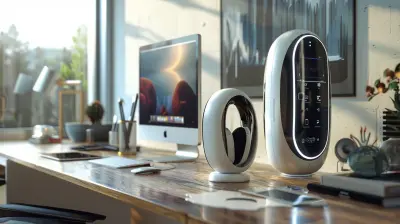
Your desk in 2027 is not a slab of wood. It is a command center with a soul. Imagine a surface that is entirely touch-sensitive. Not just for your fingers, but for your devices. You place your tablet down, and the desk recognizes it. It integrates the screen into its own surface. You can drag files from your tablet directly onto the desk, and they appear as holographic projections floating an inch above the wood.But here is the kicker: the desk tracks your posture through a lattice of pressure sensors. If you start slouching, it does not buzz or beep. That is annoying. Instead, it gently vibrates the surface, like a cat purring, to remind you to sit up. It also monitors your typing force. Are you hammering the keys? That means stress. The desk will subtly raise itself to standing height, forcing you to shift your body and reset your mood.
There is also a built-in wireless charging grid that does not require you to place your phone on a specific pad. Anywhere on the desk works. It uses resonant inductive coupling. You just toss your phone down, and it charges. No thinking. No cables. It is the kind of frictionless design that makes you wonder how you ever lived with a tangled mess.

The Light That Changes Your Brain
Lighting in a 2027 home office is not about brightness. It is about biology. We have all heard of blue light filters, but that is child's play. The new generation of smart lighting uses full-spectrum LEDs that mimic the exact color temperature of the sun at any given moment. But it goes deeper.Your office lights are tied to your calendar. When you have a high-stakes video call, the lights shift to a cool, neutral white that reduces shadows on your face, making you look like a professional broadcaster. When you are deep in creative work, the lights diffuse into a soft, warm glow that reduces eye strain and encourages divergent thinking.
And then there is the "deep focus" mode. This is where it gets poetic. The lights will dim to a specific lux level, and a single, narrow beam will illuminate only your keyboard and your notes. The rest of the room falls into a gentle darkness. It is like sitting under a reading lamp in a quiet library, but the lamp is the entire ceiling, and it knows exactly where to point.
The sensors in the ceiling also detect your pupil dilation. If you are squinting, the light adjusts. If you are tired, it warms up to a sunset tone to signal your brain that the workday is ending. It is a silent conversation between you and the photons.

The Air You Breathe
We spend a third of our lives in our home office. The air quality in that room matters more than any gadget on your desk. By 2027, air purification is not a box in the corner. It is integrated into the walls and the floor.Think of a system that uses electrostatic precipitation to capture dust, pollen, and even viruses. But the real magic is the scent. Not the fake lavender of a cheap diffuser. I am talking about molecular scent engineering. The system can release trace amounts of natural compounds that have been proven to boost cognitive function. A hint of peppermint for alertness. A whisper of cedar for calm.
The system reads your biometrics. If your heart rate is elevated from a stressful call, it will release a subtle, grounding aroma of vetiver. It is like having a personal aromatherapist who lives in your ceiling. You will not even notice it consciously, but your body will. Your breathing will deepen. Your shoulders will drop.
And the humidity? Perfectly controlled. No more dry eyes from staring at a screen all day. The system keeps the moisture at an optimal level, and it does it silently. No hissing. No condensation. Just perfect air.
The Chair That Holds You
Let me tell you about the chair. It is not a chair. It is a support system. In 2027, the ergonomic chair has evolved into something that feels like it is hugging you.It uses memory foam that is not static. It is dynamic. The foam has micro-channels that inflate and deflate based on your movement. If you lean to the right, the left side of the seat firms up to support you. If you recline, the lumbar support shifts to match your spine's curve. It learns your body over a week. By the second week, it knows exactly where you carry tension.
There is also a heating and cooling function. Not a seat warmer like in a car. This is targeted. If your lower back is cold, it warms just that spot. If you are sweating from a workout, it cools the contact points. It is like sitting on a cloud that has a PhD in anatomy.
And the chair talks to the desk. If you have been sitting for 45 minutes, the chair will gently tilt forward, encouraging you to stand. The desk rises. It is a coordinated dance. You do not need a smartwatch to remind you to move. The room itself reminds you.
The Screen That Is Not a Screen
Monitors are dead. Long live the spatial display. By 2027, you will not look at a flat panel. You will look into a volume of light. These are holographic displays that project a 3D image in the air above your desk.No glasses. No headset. Just a floating interface that you can interact with using hand gestures. You can grab a window and throw it to the side. You can zoom into a spreadsheet by pinching the air. It sounds like science fiction, but it is already in prototype form.
The resolution is insane. It uses a laser-based retinal projection that creates the illusion of infinite depth. You can have a 34-inch monitor that takes up no physical space on your desk. When you are done, you just wave your hand, and the display disappears. Your desk is clean. Empty. Ready for a notebook and a pen.
And the best part? Eye strain is gone. Because the light is not a direct source. It is reflected off microscopic particles in the air. Your eyes focus naturally, like they would on a distant mountain. You can stare at it for eight hours and not feel the burn.
The Connection That Is Everywhere
Wi-Fi 8 is here. But that is boring. What matters is the mesh. Your home office in 2027 is a single, seamless network. It is not just for your laptop. It is for everything.Your lights, your desk, your chair, your air purifier, your walls, your coffee mug (yes, your mug). They all talk to each other on a low-latency, encrypted protocol that does not clog your bandwidth. You can walk into the room, and your devices authenticate instantly. No passwords. No QR codes. The room recognizes your gait, your breathing pattern, your unique electromagnetic signature.
And if the internet goes down? The office does not die. It has a local server that caches your essential apps and files. You can keep working offline. The system syncs when the connection comes back. It is like a backup brain for your digital life.
The Ritual of Endings
Here is the part nobody talks about. How do you leave the office? In 2027, the room helps you transition. When your workday is over, you say a simple command. Or you just stand up and walk toward the door.The lights dim to a warm, cozy tone. The desk lowers to its resting position. The air purifier shifts to a night mode that circulates lavender. The walls turn to a soft, dark blue. The screen dissolves into nothing. The room transforms from a productivity machine into a quiet sanctuary.
You step out, and the door closes behind you. The room goes into a low-power state. It is not sleeping. It is listening. Waiting for you to come back tomorrow.
This is the future. It is not about gadgets. It is about a relationship between you and your space. A partnership. The room is not a tool. It is a teammate. It knows when to push you and when to let you rest.
Designing a smart home office with 2027 tech is not about buying the most expensive stuff. It is about building a system that respects your rhythm. It is about creating a place where you can do your best work without sacrificing your sanity.
So, start now. Think about the air. Think about the light. Think about the chair. The rest will follow.
all images in this post were generated using AI tools
Category:
Tech For Remote WorkAuthor:

Ugo Coleman
Discussion
rate this article
1 comments
Carson Fry
Innovative connectivity enhances productivity.
June 20, 2026 at 2:48 AM
Ugo Coleman
Absolutely, innovative connectivity can transform how we work and increase efficiency in a smart home office.