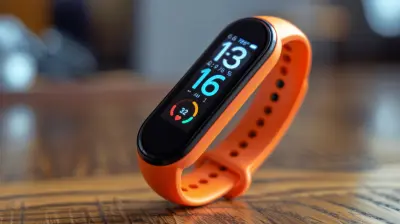
How AI is Enhancing Your Bluetooth Experience
26 November 2026
Bluetooth has become one of those technologies we stop noticing until it fails. You pair your earbuds, get in the car, and expect the audio to just flow. When it does, you never think about it. When it doesn't, you spend ten minutes in a parking lot toggling settings and muttering at your phone. What most people don't realize is that a growing share of the intelligence that keeps that connection stable, the audio clean, and the battery alive no longer lives in the Bluetooth radio itself. It lives in software models that predict, adapt, and correct in real time. That is where AI has quietly reshaped the experience, and understanding how it works changes how you choose devices, troubleshoot problems, and set expectations.

The Core Problem AI Solves in Bluetooth
Classic Bluetooth is a narrow, crowded, and noisy radio link. It hops across 79 channels in the 2.4 GHz band (40 channels in Bluetooth Low Energy), sharing spectrum with Wi-Fi, microwave ovens, wireless mice, and every other nearby device. The protocol has always included error correction and retransmission, but those mechanisms are reactive: a packet gets corrupted, and the system tries again. That costs latency, power, and audio quality.AI shifts the approach from reactive to predictive. Instead of waiting for interference, machine learning models trained on radio behavior can forecast which channels will degrade, which codec settings will hold up, and which packets are worth retransmitting. This matters because Bluetooth operates under hard constraints. Latency budgets for gaming audio are measured in tens of milliseconds. Power budgets for a coin-cell sensor are measured in microamps. A reactive system spends those budgets inefficiently; a predictive one spends them where they count.
Think of it like driving. A reactive driver brakes hard when the car ahead slows. A predictive driver anticipates the slowdown from traffic patterns and adjusts gradually. Both arrive, but one burns less fuel and gives passengers a smoother ride. That is the difference AI brings to the radio link.
Adaptive Audio: Codecs That Learn Your Environment
The most visible AI impact is in audio. Modern Bluetooth audio depends on codecs like SBC, AAC, LC3, and various proprietary formats, each balancing bitrate against quality and latency. Historically, the codec settings were fixed at pairing or adjusted through crude heuristics based on signal strength.Newer implementations use learned models to make those decisions continuously. The system watches packet loss rates, retransmission patterns, and buffer occupancy, then adjusts bitrate and error concealment in real time. When you walk past a busy train station and the 2.4 GHz band fills with interference, the audio doesn't stutter; it gracefully trades a bit of high-frequency detail for stability, then restores quality once you clear the crowd. The listener often never notices the transition, which is precisely the point.
There is a real trade-off here. Aggressive adaptation can make audio sound inconsistent, with subtle pumping or dulling as the system reacts. Conservative adaptation preserves quality but risks dropouts. The best implementations use learned models to distinguish between transient interference (a passing microwave burst) and sustained congestion (a packed office), responding differently to each. When you evaluate earbuds or headphones, this is worth testing in a crowded public space rather than a quiet room. A device that sounds flawless in silence tells you almost nothing about its adaptive intelligence.

Noise Cancellation and Beamforming: Where AI Is Most Audible
Active noise cancellation has used digital signal processing for years, but the shift to learned models changed what is possible. Traditional ANC inverts ambient noise using fixed filters tuned for broad categories like airplane cabin or street traffic. Neural network based ANC can model the specific acoustic path from the outside microphone to your eardrum, adapting to how the headphones actually sit on your head.The practical result is better performance in the awkward cases. Loose fit, glasses arms breaking the seal, jaw movement while talking: these degrade fixed-filter ANC noticeably. Adaptive systems compensate. They also handle non-stationary noise, like a conversation nearby or a dog barking, better than filters designed for steady droning sounds.
Beamforming for voice calls follows the same logic. Microphone arrays can steer sensitivity toward the speaker's mouth and away from noise, but the steering depends on knowing where the voice is coming from. AI models trained on speech and noise signatures improve that discrimination, which is why call quality on modern earbuds in windy conditions is dramatically better than it was five years ago.
The trade-off to understand: neural ANC consumes more compute, which draws power. Some devices let you choose between maximum cancellation and maximum battery life for this reason. If you commute two hours a day, the power cost is worth it. If you wear earbuds for eight-hour workdays, a moderate setting may serve you better. Check whether your device exposes that choice, because many bury it in an app.

Connection Stability and Multipoint Intelligence
Multipoint pairing, where headphones connect to a laptop and a phone simultaneously, has existed for years but often worked poorly. The classic failure mode: you are on a call on your laptop, your phone rings, and the headset either ignores it or switches clumsily, dropping audio mid-sentence.AI improves arbitration. Learned models weigh signals like which device is actively streaming, which has an incoming call, recent user behavior, and even calendar context in some ecosystems, to decide when to switch and when to stay. The improvement is subtle but meaningful: fewer wrong-device moments, faster reconnection after sleep, and smarter handling of the case where you walk out of range of one device while staying connected to another.
This is also where misconceptions abound. People assume multipoint means seamless switching, but the Bluetooth specification doesn't mandate behavior, and implementations vary widely. Two devices with identical chipsets can behave differently because the arbitration logic is vendor-specific. Before buying, look for concrete reports about multipoint behavior with your specific phone and laptop combination rather than trusting the feature bullet. Firmware updates also change this behavior over time, sometimes for the better, occasionally introducing regressions.
Power Management and Battery Prediction
Battery life claims on Bluetooth devices are notoriously optimistic, and AI is part of both the problem and the solution. On the problem side, vendors can tune power models to produce favorable lab numbers. On the solution side, learned power management genuinely extends real-world runtime.The mechanism is straightforward in principle. Instead of running the radio at a fixed power level, the system predicts link quality from recent history and adjusts transmit power, connection interval, and sleep scheduling accordingly. A headset sitting on a desk with a strong link can drop to very low duty cycles. One moving through a house with walls between it and the phone ramps up. Predictive models smooth these transitions so the device doesn't thrash between states, which itself saves power.
Battery percentage estimates also benefit. Classic fuel gauges based on voltage curves are inaccurate, especially for the small cells in earbuds. Models that learn your usage patterns produce estimates that don't jump from 40 percent to 15 percent in ten minutes. If you have ever had earbuds die unexpectedly, you have experienced a crude estimator. Newer devices are better, but the accuracy still depends on how much usage data the model has seen, so a brand-new pair may estimate poorly for the first week or two.
AI in Hearing Aids and Accessibility
Some of the most consequential AI work in Bluetooth audio is in accessibility. Hearing aids and over-the-counter hearing devices increasingly use Bluetooth LE Audio, and AI plays a role in personalization. Learned models can amplify speech frequencies while suppressing background noise based on the user's audiogram and environment, and they can do it with latency low enough to feel natural.The LE Audio standard, with its LC3 codec and Auracast broadcast capability, opens possibilities that AI makes practical: a venue streams audio directly to hearing devices, and the device applies personalized enhancement in real time. This is not hypothetical; it is shipping in public spaces and theaters in various countries. If you or someone you know uses hearing assistance, the combination of LE Audio and on-device AI is the most important development in the category in years, and it is worth asking audiologists specifically about Bluetooth LE Audio support when choosing devices.
Common Mistakes and Misconceptions
Several beliefs about AI and Bluetooth deserve correction.First, AI does not fix bad hardware. A poorly tuned antenna or a cheap DAC limits what any model can do. Software intelligence amplifies good engineering; it does not replace it. This is why two earbuds with the same chip can perform very differently.
Second, on-device versus cloud processing matters. Almost all real-time Bluetooth AI runs on the device, because round-tripping audio to a server would add latency no one would tolerate. Claims about "AI-powered" audio that imply cloud processing are usually marketing dressed up. The interesting work happens in tiny models running on constrained silicon.
Third, firmware updates are not optional. Many AI features ship after launch or improve over time. A device you dismiss based on launch reviews may be substantially better a year later. Conversely, an update can regress behavior. Check release notes before updating, and keep a working configuration in mind in case you need to roll back, which most consumer devices don't allow.
Fourth, more AI is not automatically better. Every model consumes power and adds complexity. A simple, well-tuned fixed configuration can outperform an over-eager adaptive system that oscillates between states. Judge by outcomes in your actual environment, not by feature lists.
Practical Guidance for Buyers and Users
When evaluating a Bluetooth device, test the AI-dependent behaviors specifically:- Walk through a crowded area and listen for dropouts or sudden quality shifts.
- Take a call outdoors on a windy day and ask the other party how you sound.
- Pair with two devices and trigger an incoming call on the non-active one to see how switching behaves.
- Wear the device for several days before judging battery estimates, since models need data.
- Check the companion app for controls over ANC intensity, codec preference, and power modes. Good implementations expose these; poor ones hide them.
For troubleshooting, remember that most "AI" fixes are probabilistic. If audio stutters, the model may be choosing stability over quality because it misread the environment. Moving away from the interference source, or manually locking a codec or connection mode, often helps more than repeated re-pairing.
What Comes Next
The trajectory is toward more contextual intelligence: devices that know you are in a meeting, on a run, or on a plane, and configure themselves accordingly, with privacy-preserving on-device processing. LE Audio and Auracast will expand what Bluetooth carries, and AI will be the layer that makes that abundance usable rather than overwhelming. The Bluetooth radio itself will keep improving incrementally; the experience will improve in leaps because of the software intelligence layered on top.The practical takeaway is simple. Stop evaluating Bluetooth devices on specs alone. The specs describe the ceiling. AI determines how close to that ceiling you actually get, day to day, in the noisy, crowded, imperfect environments where you actually use them.
all images in this post were generated using AI tools
Category:
Bluetooth DevicesAuthor:

Ugo Coleman