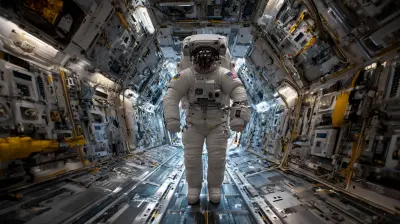
Space Farming: Growing Crops on Mars and Beyond
20 June 2026
Have you ever wondered what it would be like to grow crops on Mars? How about farming in the cold, desolate vacuum of space? It sounds like something straight out of a sci-fi movie, but in reality, space farming is closer to becoming a necessity than you might think. As humanity sets its sights on colonizing Mars and exploring deeper into space, one question looms large—how will we feed ourselves?
Earth's resources are finite, and as we venture further from our home planet, it's clear that relying on shipments of food from Earth just won’t cut it. That’s where space farming comes in. Space farming is the process of growing crops in extraterrestrial environments, be it on Mars, the Moon, or even in space stations. But the challenges are out of this world—literally.
In this article, we’ll dive into the nitty-gritty of what it takes to grow food on Mars and beyond. So, grab your space helmet, and let’s explore the future of farming in space!
Why Do We Need Space Farming?
Before we get into the "how," let’s address the "why." Why is space farming so crucial?As humans continue to explore and settle in space, the need for sustainable food systems becomes vital. Think about it—sending food from Earth to Mars, which is around 140 million miles away (depending on the planetary alignment), would be incredibly costly, time-consuming, and risky. Plus, if we’re serious about long-term colonization of planets like Mars, we can’t rely on Earth-based food supplies forever.
Growing food locally in space or on Mars would not only make space missions more sustainable but also ensure that astronauts and future space settlers have access to fresh, nutritious food. This could reduce dependency on pre-packaged space meals, which, let’s be honest, probably get old after a while.
In short, space farming is the key to future space exploration and colonization. Without it, our dreams of living on Mars might remain just that—dreams.
The Challenges of Space Farming
Now, before you start imagining fields of wheat swaying in the Martian breeze, let’s get real. Space farming is no walk in the park. There are tons of challenges that scientists and engineers need to overcome. Let’s break it down:1. Gravity (Or Lack Thereof)
One of the biggest hurdles? Gravity. Or more accurately, the fact that Mars has only about 38% of Earth’s gravity, and in space, there’s close to none. Plants have evolved for millions of years under Earth’s gravitational pull, and they rely on it to determine which way to grow.In microgravity environments like space stations, plants can get confused. Their roots might grow in weird directions, and their stems might not grow upright. However, researchers aboard the International Space Station (ISS) are already experimenting with growing plants in microgravity. They’ve had some successes with crops like lettuce, wheat, and even zinnias (a type of flower). But Mars's lower gravity presents a whole new set of questions—will plants thrive in this lighter environment, or will they struggle?
2. Atmosphere and Air Composition
Next up: atmosphere. Mars has a thin atmosphere composed mainly of carbon dioxide, with almost no oxygen or nitrogen—two elements Earth plants depend on. This means we can’t just plop seeds into Martian soil and hope for the best. We'll need controlled environments—think greenhouses or biodomes—where we can regulate air composition, temperature, and pressure to mimic Earth-like conditions.In space, things get even trickier since there’s no atmosphere at all. Any space farming efforts would need to take place in highly controlled environments where air, temperature, and humidity can be precisely managed.
3. Soil Conditions (Or Lack Thereof)
Here’s another biggie: soil. Martian soil, also known as regolith, isn't exactly fertile farmland. It’s filled with toxic chemicals like perchlorates, which are harmful to humans and plants. Not only that, but it lacks the organic materials that Earth plants depend on for nutrients.To make Martian soil usable, scientists are experimenting with ways to treat it and add nutrients. One option is to create soil from scratch using organic waste, compost, and other materials. Another idea is to grow plants hydroponically, meaning without soil, using nutrient-rich water solutions instead.
4. Water Availability
Speaking of water—Mars isn’t exactly overflowing with the stuff. While there’s evidence of frozen water at Mars's poles and possibly underground, liquid water is scarce due to the planet’s low atmospheric pressure. Extracting and purifying water will be a critical challenge for space farmers.In space stations, water is already a precious commodity. NASA has developed technologies to recycle water from astronauts' sweat and even urine. While this sounds, well, gross, it’s a testament to how every single drop of water will need to be conserved and reused in space farming systems.
5. Radiation
Last but definitely not least: radiation. Space and Mars both have much higher levels of radiation than Earth because they lack the protective magnetic fields and thick atmospheres that our planet enjoys. This radiation can damage plants’ DNA, stunting growth or killing them outright.To combat this, we’ll need to grow crops in protected environments—like underground or in shielded greenhouses—that block harmful radiation. That’s easier said than done, but it’s a challenge that scientists are actively working on.
The Role of Technology in Space Farming
So, how do we overcome these challenges? Enter technology. From advanced hydroponics to genetically engineered crops, tech is the cornerstone of space farming. Let’s look at how technology is making space farming a reality:Hydroponics and Aeroponics
One of the most promising solutions for space farming is hydroponics—a method of growing plants without soil by using a nutrient-rich water solution. Hydroponics is already widely used on Earth, especially in urban farming, and it’s a natural fit for space. It allows for precise control over nutrients, water usage, and environmental conditions.Then there’s aeroponics, where plants are grown in an air or mist environment without soil or an aggregate medium. This method uses even less water than hydroponics and is being tested as a potential option for space farming.
Both of these methods could allow astronauts to grow food in confined spaces, like space stations or Martian habitats, without needing vast amounts of soil or water.
Artificial Light and Climate Control
Since Mars is farther from the Sun than Earth, its light levels are lower, which could affect plant growth. Plus, space stations are often in darkness for long periods. To get around this, scientists are looking at using LED grow lights to mimic sunlight. These lights can be fine-tuned to provide the exact wavelengths of light that plants need for photosynthesis.In addition to light, temperature, humidity, and CO2 levels will need to be tightly controlled using climate control systems. This tech will be crucial in creating stable environments where crops can thrive, whether in space or on Mars.
Genetic Engineering
In the future, we might not just grow Earth plants in space; we could grow genetically modified plants that are specially designed to thrive in extraterrestrial environments. Imagine plants that are more resistant to radiation, grow faster, or require less water. Genetic engineering could make this a reality.Scientists are already working on crops that can tolerate extreme conditions, and this research could be applied to space farming. For example, crops like potatoes and tomatoes are being studied for their potential to grow in space, and genetic engineering could make them even more robust.
The Future of Space Farming: What’s Next?
So, what does the future hold for space farming?In the next few decades, we could see the first Martian greenhouses built by astronauts living on Mars. These structures will likely use a combination of hydroponics, artificial light, and climate control to grow a variety of crops, providing fresh food for the crew.
In space, we could see more advanced farming systems aboard space stations, growing not just simple crops but a variety of fruits, vegetables, and even herbs. Long-term missions to the Moon, Mars, or beyond could rely entirely on these systems for food.
And who knows? In the distant future, we might even terraform Mars or other planets, making them suitable for large-scale agriculture. It’s a long shot, but the idea of transforming barren landscapes into lush farmlands isn’t as far-fetched as it once seemed.
Final Thoughts
Space farming is no longer the stuff of science fiction—it’s rapidly becoming a necessity for the future of space exploration. With the challenges of gravity, atmosphere, soil, water, and radiation, we have our work cut out for us. But thanks to innovations in hydroponics, genetic engineering, and climate control, we’re getting closer to growing food in space and on Mars.As we continue to explore the cosmos, one thing is clear: if we want to live among the stars, we’ll need to bring our farms with us.
all images in this post were generated using AI tools
Category:
Space TechnologyAuthor:

Ugo Coleman
Discussion
rate this article
1 comments
Emmett Rios
Innovative approaches to crop cultivation could transform space exploration.
June 20, 2026 at 11:47 AM
Ugo Coleman
Absolutely! Innovative crop cultivation methods are key to sustaining life on Mars and beyond. They could revolutionize how we approach space missions and long-term habitation.